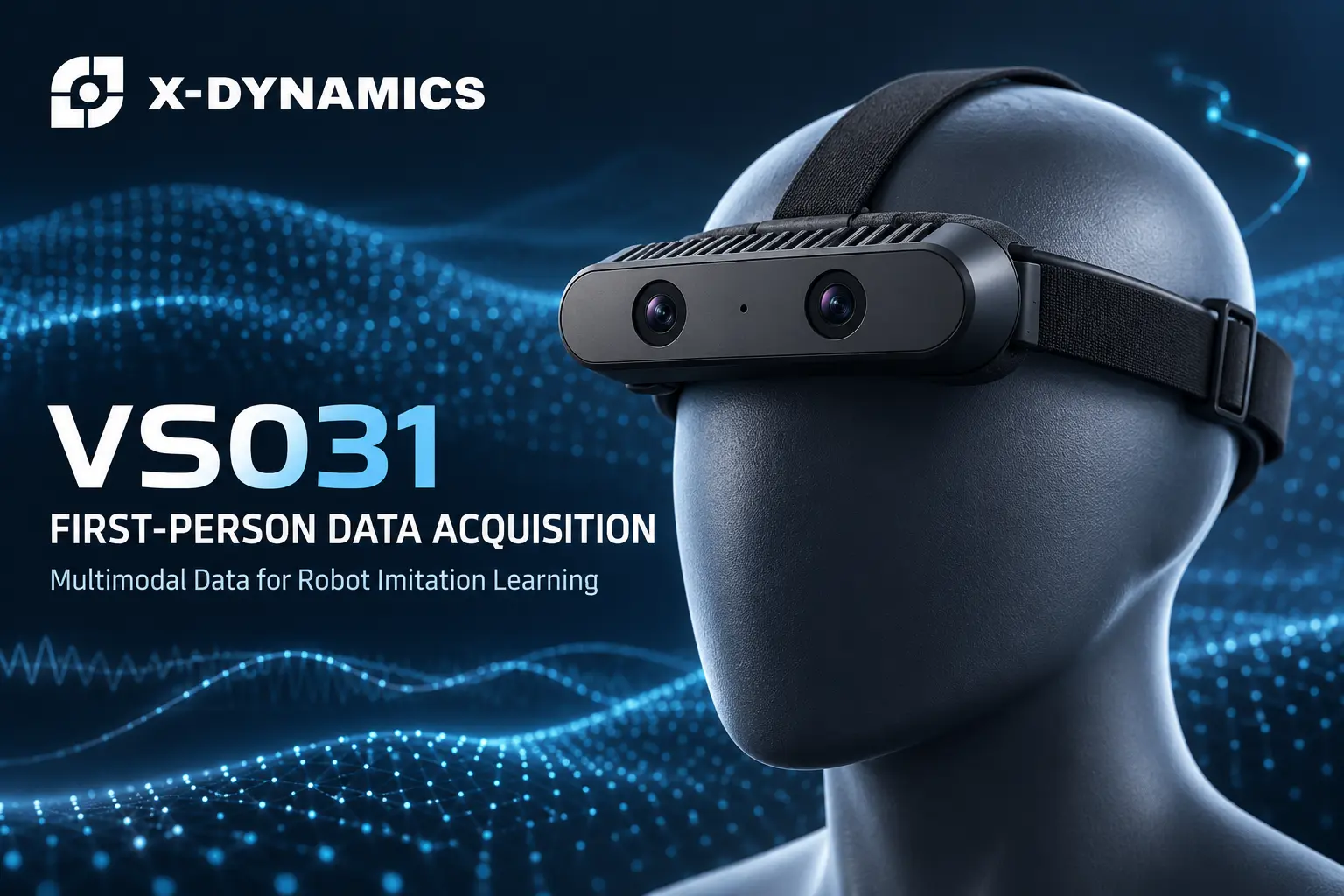
VS031 Wearable First-Person Data Acquisition Terminal for Robot Imitation Learning
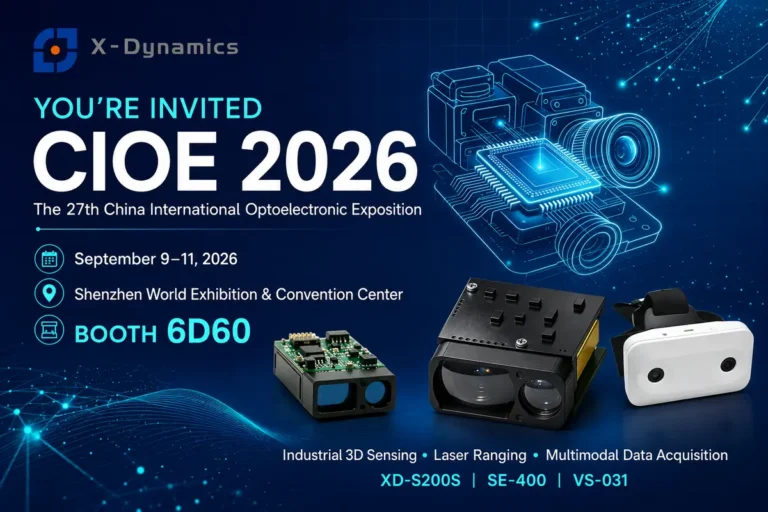
The X-Dynamics VS031 captures synchronized binocular video, head-motion and audio data from the operator’s first-person perspective, providing structured multimodal datasets for robot imitation learning, industrial automation and embodied AI development.
As embodied intelligence and industrial robotics move toward real-world deployment, imitation learning is becoming an important way for robots to acquire practical operating skills.
Instead of programming every movement manually, developers can collect demonstrations from experienced operators and use this data to train robots to reproduce similar procedures. However, the quality of imitation learning depends heavily on how the demonstration data is captured.
Traditional robot teaching methods often rely on manually guiding a robotic arm or recording operations from fixed external cameras. These approaches can be useful, but they may provide limited coverage of the operator’s actual viewpoint, head movement and interaction with the surrounding environment.
The X-Dynamics VS031 Wearable First-Person Multimodal Data Acquisition Terminal introduces a different approach: the operator wears the device while completing a normal task, and the terminal synchronously records binocular visual data, head-motion information and environmental audio.
This creates a data foundation that more closely reflects how a person observes and performs real industrial work.
Capturing Operations from the Human Point of View
In robot imitation learning, perspective matters.
A fixed camera may capture the overall process, but it does not always show what the operator is focusing on at each moment. Important details—such as hand position, component alignment, tool movement or the condition of a workpiece—may be partially blocked or recorded from an unsuitable angle.
The VS031 uses a head-mounted design to capture the task from the operator’s natural first-person perspective. Its binocular 1080p acquisition module uses global-shutter imaging and provides a horizontal field of view of at least 130°.
This wide viewing angle helps record:
- Hand and tool movements
- Workpiece details
- The surrounding workstation
- Changes in the operator’s viewing direction
- Interactions between the operator and equipment
Because the device moves together with the wearer, the recorded visual data remains closely connected to the operator’s attention and working process.
Global-Shutter Binocular Imaging for Dynamic Tasks
Fast hand movements can be difficult to record clearly with conventional rolling-shutter cameras. Motion distortion and image blur may reduce the value of training data, particularly in tasks involving rapid tool use, component placement or material handling.
The VS031 uses global-shutter binocular imaging to capture dynamic operations more clearly. All pixels are exposed at the same time, helping reduce motion-related distortion when the operator or surrounding objects are moving.
This makes the terminal suitable for recording demonstrations such as:
- Precision assembly
- Component installation
- Material sorting
- Equipment inspection
- Machine adjustment
- Tool-based operations
- Mobile maintenance tasks
The binocular configuration also provides two synchronized visual streams, supporting the development of perception and spatial-analysis workflows where stereo information is required.
Synchronized Visual, Motion and Audio Data
Human skills cannot always be understood from video alone.
An operator’s head movement may indicate where attention shifts during a task, while environmental sounds can provide additional information about machine status, tool contact or process completion.
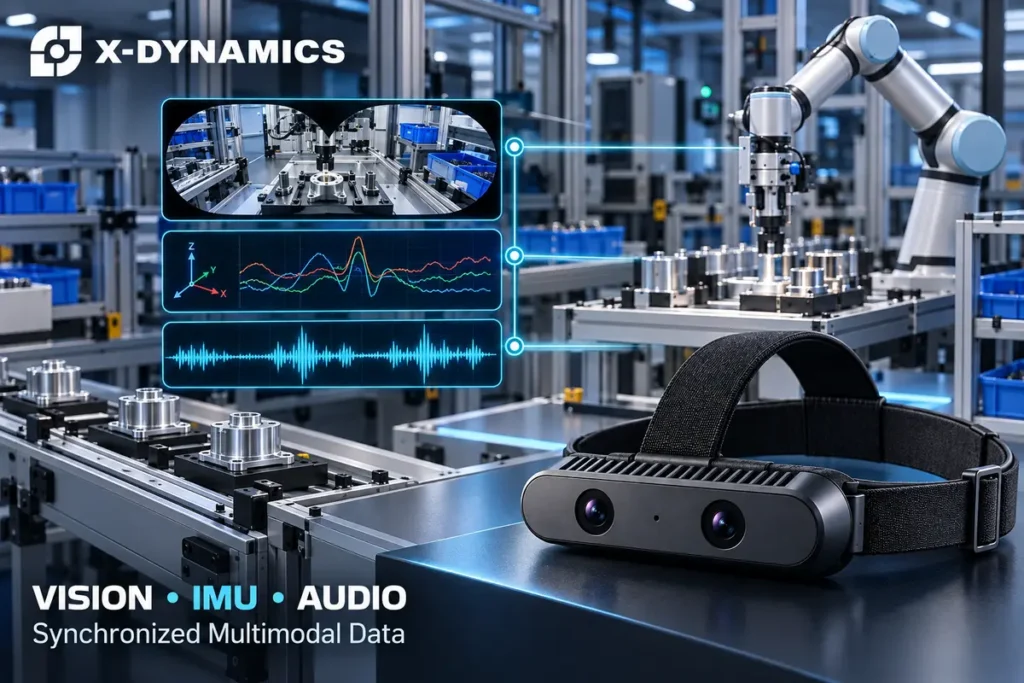
The VS031 integrates three data sources:
- Binocular visual data
- Six-axis IMU data
- Environmental audio
Its six-axis IMU records head posture and movement at up to 200 Hz, capturing changes in orientation, movement rhythm and viewing behavior throughout the demonstration.
The audio system records environmental and operational sounds that may serve as additional contextual information. For example, a click, impact, motor sound or alarm may correspond to a particular stage of an industrial procedure.
Hardware-level timestamps align the different data streams along a common timeline. This synchronization helps developers analyze the relationship between what the operator sees, how the operator moves and what happens in the surrounding environment.
Lightweight Design for Natural Demonstration
Demonstration data is most useful when the operator can work naturally.
A heavy or restrictive device may change body posture, slow down movements or interfere with normal hand operations. This can make the collected data less representative of the real production process.
The VS031 weighs approximately 200 grams and is designed for lightweight head-mounted use. It does not occupy the operator’s hands and is intended to minimize obstruction of the normal working view.
Operators can therefore perform familiar tasks without having to constantly adjust their movements to accommodate a fixed camera position.
This is particularly useful for collecting demonstrations in:
- Assembly workstations
- Warehouse picking areas
- Production lines
- Inspection routes
- Equipment rooms
- Maintenance and commissioning environments
The wearable design also allows data collection to continue as the operator moves between different positions or work areas.
Flexible Storage, Transmission and Power Options
Industrial data collection may take place at a fixed workstation, across a production line or during a mobile inspection route. The VS031 provides several options for different deployment conditions.
The terminal supports:
- MicroSD local high-speed storage
- USB Type-C data transmission
- Wi-Fi wireless transmission
- USB power supply
- External mobile power supply
Local storage allows demonstrations to be recorded when a stable network connection is unavailable. USB Type-C can be used for high-speed data transfer, while Wi-Fi supports wireless access in suitable environments.
The combination of USB and mobile power options also gives developers greater flexibility when planning short recording sessions or longer data-collection tasks.
Supporting Robot Imitation-Learning Workflows
The VS031 is designed to generate structured, synchronized multimodal data for robot-learning projects.
Depending on the training framework and project requirements, the collected data can be organized, annotated and processed for imitation learning, behavior cloning, multimodal representation learning and other embodied-AI workflows.
A typical development process may include:
- Defining the task and data requirements
- Recording demonstrations from experienced operators
- Reviewing and filtering the collected data
- Annotating key actions, objects or task stages
- Converting the dataset for the selected training framework
- Training and validating the robot model
- Testing performance in the real operating environment
The amount of data required depends on task complexity, environmental variation, robot configuration and the selected learning method. For this reason, repeatable data collection and consistent synchronization are essential when building a reliable training dataset.
Potential Industrial Applications
Precision Assembly
First-person video can capture how an operator positions components, selects tools and checks alignment during an assembly process. IMU and audio data provide additional context for analyzing the sequence and rhythm of the operation.
Logistics and Material Sorting
The VS031 can record how workers identify, pick, move and place different objects. These demonstrations may support research and development involving robotic picking, sorting and warehouse automation.
Equipment Inspection
During inspection tasks, the terminal can capture the operator’s viewing direction, movement path and environmental feedback. This data may help developers study how experienced personnel identify abnormalities or follow inspection procedures.
Machine Adjustment and Commissioning
The device can record the complete process of adjusting controls, observing equipment responses and confirming operating conditions, helping preserve practical knowledge from skilled technicians.
Human–Robot Collaboration
First-person datasets can also support research into how people interact with tools, machines and robotic systems within a shared workspace.
Turning Human Experience into Trainable Data
Many valuable industrial skills exist primarily in the experience of trained operators. These skills can be difficult to describe completely through written instructions or conventional programming.
By capturing operations from the wearer’s first-person perspective and synchronizing visual, motion and audio information, the VS031 helps convert practical demonstrations into reusable digital datasets.
It provides a flexible data-acquisition tool for robotics developers, research institutions, system integrators and manufacturers working on imitation learning, embodied intelligence and industrial automation.
As robots become increasingly dependent on real-world training data, reliable first-person multimodal acquisition will play an important role in transferring human operating experience into machine-learning workflows.