Large-Cargo Volume Measurement in About 10 Seconds: A Multi-Camera Vision Solution for Warehousing
X-Dynamics’ large-cargo measurement solution combines a five-camera vision array, 3D reconstruction, integrated weighing and data management. Under the tested configuration, it can complete a measurement cycle in about 10 seconds and handle cartons, bags, foam containers, wooden crates and other common cargo types.
The Challenge of Measuring Large and Irregular Cargo
In warehouses, e-commerce distribution centers and factory logistics operations, cargo dimensions and weight directly affect freight calculation, storage allocation and operational planning.
However, measuring large cargo manually is often slow and inconsistent. Operators need to measure the length, width and height separately, record the weight, enter the information into a system and sometimes capture additional images for verification.
The process becomes even more challenging when handling soft bags, irregular foam containers or non-standard packages. Conventional measurement equipment may work well with regular cartons but struggle to describe the actual space occupied by irregular cargo.
To address these challenges, X-Dynamics has developed a multi-camera vision solution that integrates rapid measurement, 3D data acquisition and digital record management into one workflow.
Five-Camera Vision for 3D Cargo Measurement
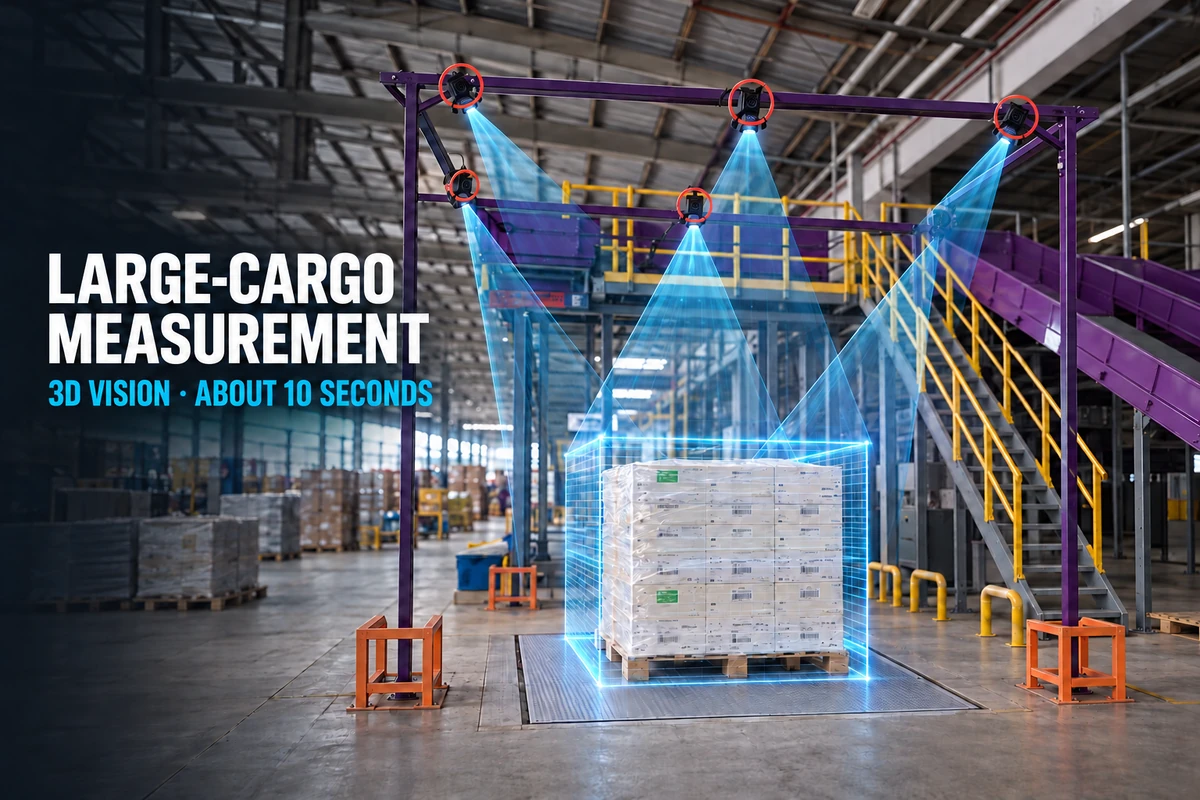
The system uses five downward-facing cameras installed on a supporting structure approximately four meters above the measurement area.
By capturing the cargo from multiple viewpoints, the system combines image and depth information to reconstruct its three-dimensional shape. The software then calculates the cargo’s length, width, height and volume without requiring physical contact with the object.
Compared with a single fixed camera, the multi-camera configuration provides more complete coverage of the cargo surface. It helps reduce blind spots and improves measurement stability when processing large or irregularly shaped items.
Depending on the selected camera configuration, active depth-sensing technology can also provide reliable 3D information in controlled warehouse environments.
A Measurement Cycle of About 10 Seconds
Speed is essential in high-throughput logistics operations. Under the tested system configuration, one cargo measurement cycle can be completed in approximately 10 seconds.
Once an item is positioned in the measurement area and its barcode is scanned, the system automatically:
- Captures synchronized images and depth data
- Reconstructs the cargo’s 3D shape
- Calculates its dimensions and volume
- Reads weight data from the integrated weighing equipment
- Links the results to the cargo identification code
- Saves the measurement record and corresponding images
This automated workflow reduces repetitive manual operations and helps improve throughput without adding unnecessary complexity for frontline workers.
Actual processing time may vary depending on the site workflow, equipment configuration and integration requirements.
Key Performance Indicators
Under the tested operating conditions, the system achieved the following performance:
- Measurement time: approximately 10 seconds per item
- Integrated weighing error: within ±1.5 kg
- Length, width and height error: within ±10 cm
- Supported cargo size: from 30 × 30 × 30 cm to 2 × 2 × 2 m
- Continuous operation test: 10 hours without measurement-record generation errors
It is important to distinguish between the different sensing functions. Cargo dimensions and volume are calculated using the vision system, while weight information is provided by integrated weighing hardware.
Final measurement performance can be affected by camera calibration, installation height, cargo placement, surface characteristics, occlusion and environmental conditions. X-Dynamics can therefore adapt the system configuration to the requirements of each deployment.
Three-Step Operation
The solution is designed to be easy for warehouse personnel to use and requires only three basic steps.
1. Position the Cargo
The operator moves the cargo into the designated measurement area beneath the camera array.
2. Scan the Barcode
A barcode or QR code is scanned to register the item and connect its identification information with the measurement task.
3. View and Save the Results
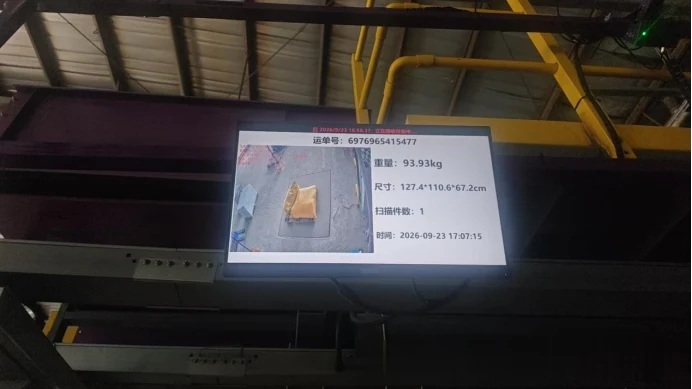
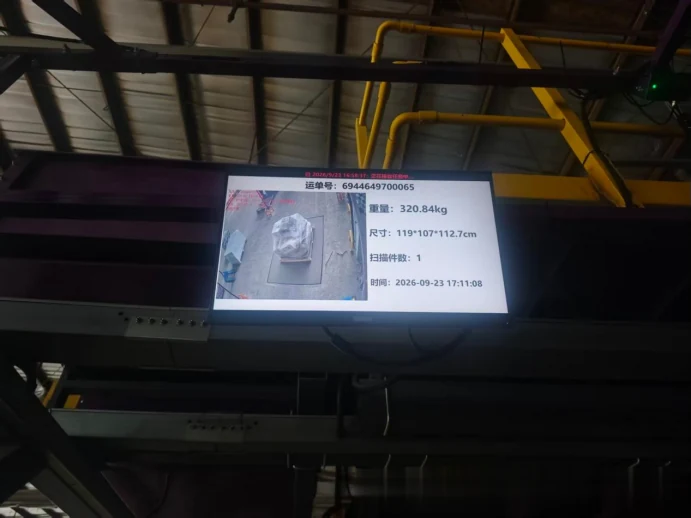
The system automatically processes the captured data and displays the cargo’s weight, dimensions, volume, images and task information on the workstation interface. The complete record is then stored for later review or export.
This straightforward workflow helps reduce training requirements and supports faster deployment on existing warehouse lines.
Compatible with Multiple Cargo Types
Real warehouse operations involve much more than standard cardboard boxes. The system can be configured for several common packaging formats, including:
Bagged Materials
Fertilizer bags, raw-material sacks and other flexible packages may deform during handling. Multi-view 3D data provides a more complete representation of their actual occupied space than simple manual length-by-width-by-height estimation.
Irregular Foam Containers
Non-standard foam packaging can contain protrusions, recessed areas or uneven surfaces. Three-dimensional reconstruction helps capture these geometric characteristics and supports more consistent volume estimation.
Regular Wooden Crates and Cartons
For standard boxes and wooden crates, the system provides fast and repeatable dimensional measurements suitable for routine warehousing, freight calculation and storage planning.
Visualized Data Management
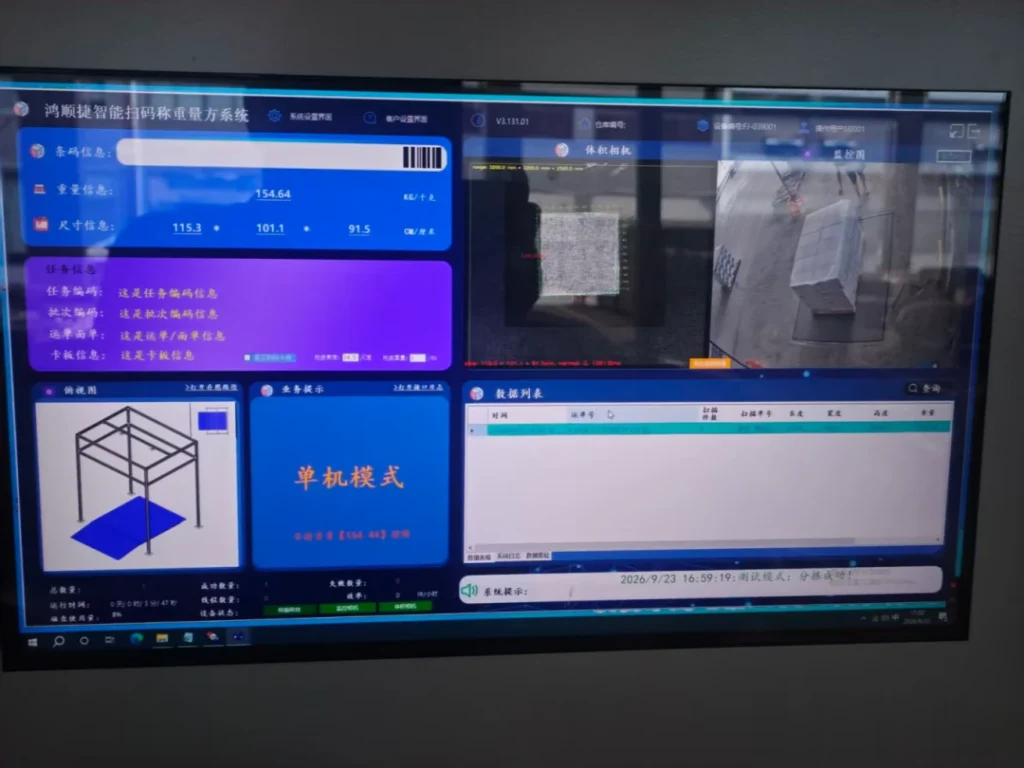
The system includes a workstation interface that brings measurement results, live images and operational records together.
The interface can display:
- Barcode and cargo identification information
- Weight data
- Length, width and height
- Calculated volume
- Current task details
- Live camera and monitoring views
- A 3D cargo preview
- Equipment operating status
- Historical measurement records
- Fault and alarm information
Each scan creates a digital record that can be searched, reviewed and exported. This allows warehouse managers to trace individual shipments, verify measurement results and use collected data for operational analysis.
Instead of leaving information in separate spreadsheets, handwritten notes or disconnected systems, the solution creates a structured dataset for warehouse scheduling, storage planning, freight settlement and cost analysis.
From Manual Measurement to Digital Operations
Automated cargo measurement is not only about replacing a tape measure. Its greater value lies in connecting physical cargo with reliable digital records.
By combining multi-camera vision, 3D reconstruction, barcode identification, weighing equipment and centralized software, the X-Dynamics solution helps businesses:
- Reduce manual measurement workload
- Improve consistency across operators and shifts
- Process large cargo more efficiently
- Measure both regular and irregular packages
- Preserve images and measurement results for traceability
- Support data-driven warehouse and logistics management
- Simplify integration with existing operational workflows
As logistics operations become increasingly digital, fast and traceable cargo measurement is becoming an important part of warehouse automation.
X-Dynamics provides industrial vision hardware, 3D sensing technology and customized system integration for logistics and manufacturing applications.
Interested in improving large-cargo measurement at your facility? Leave a comment or contact X-Dynamics to discuss your cargo types, measurement range and deployment requirements.