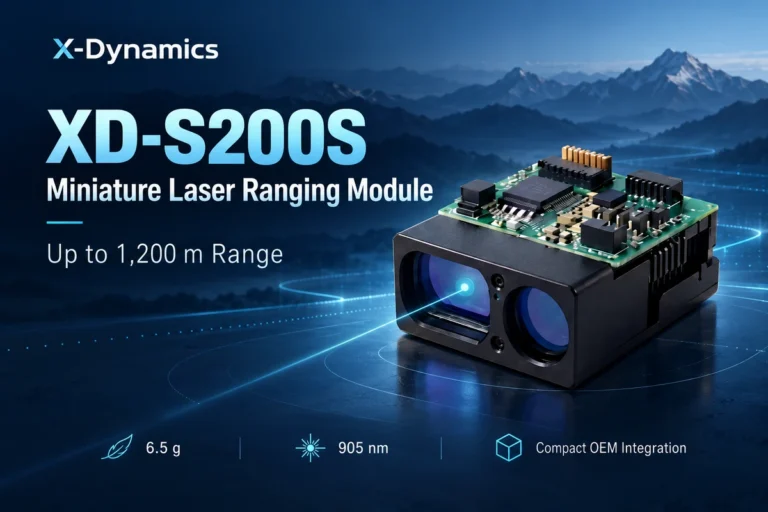
How Single-Point Laser Ranging Works: High-Precision Long-Range Detection with dToF Technology
Learn how single-point dToF laser ranging uses 905 nm laser pulses to deliver accurate long-range measurements for UAVs, rangefinders, robots and industrial sensing applications.
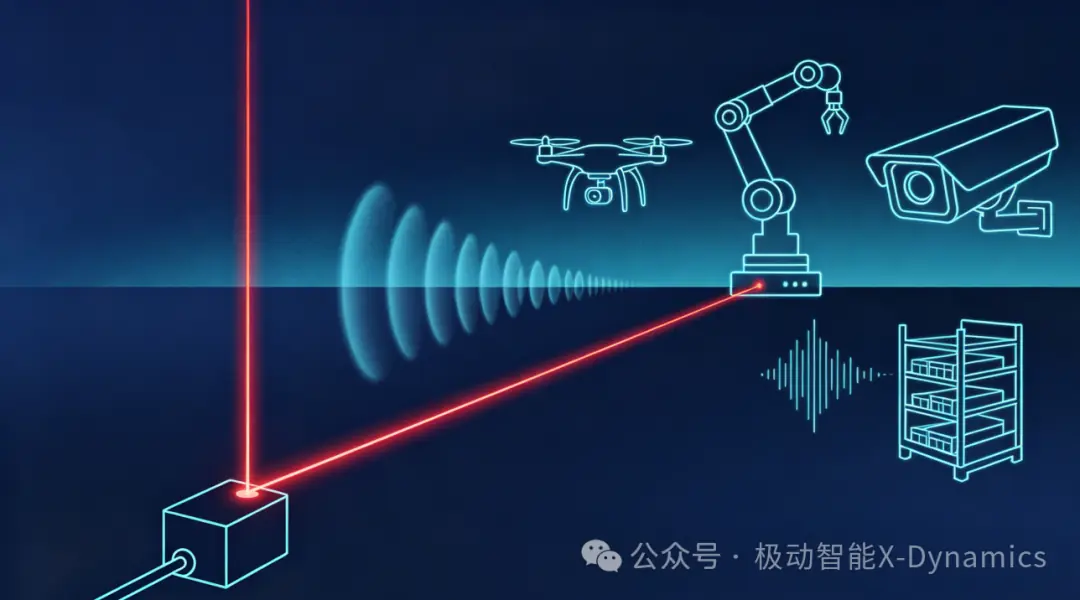
Single-point laser ranging is an essential sensing technology used in industrial measurement, UAV altitude control, robotic obstacle detection, security monitoring and intelligent logistics.
Compared with conventional ultrasonic and infrared sensors, laser ranging offers several important advantages, including longer detection distances, higher measurement accuracy, stronger resistance to interference and a narrower beam divergence angle. These characteristics make it particularly suitable for applications requiring reliable, long-range distance measurements.
What Is Single-Point Laser Ranging?
A single-point laser ranging module measures the distance between the sensor and a specific target by emitting a focused laser beam and analyzing the reflected signal.
Unlike multi-point depth cameras or scanning LiDAR systems, a single-point ranging module measures one precise direction at a time. Its compact structure, low power consumption and focused detection capability make it easy to integrate into UAVs, handheld rangefinders, optical sights, industrial equipment and other intelligent devices.
The technology provides real-time distance data that can support altitude control, target positioning, obstacle detection, equipment monitoring and automated decision-making.

How Does dToF Laser Ranging Work?
X-Dynamics single-point laser ranging modules use direct Time-of-Flight, commonly known as dToF, to calculate the absolute distance to a target.
The module emits a high-frequency 905 nm laser pulse that meets applicable eye-safety requirements. The laser travels through the air, reaches the target surface and is reflected toward the receiving unit.
A high-speed processing chip records the time interval between the emission of the laser pulse and the detection of the returning signal. Because the speed of light is known, the target distance can be calculated using the following formula:
Distance = Speed of Light × Time of Flight ÷ 2
The result is divided by two because the measured time includes both the outward journey from the module to the target and the return journey from the target to the receiver.
Unlike phase-based measurement methods, dToF determines distance directly from the travel time of the laser pulse. This approach is well suited to long-range detection and can maintain reliable measurement performance across complex operating environments.

Core Advantages of Single-Point dToF Ranging
1. Adjustable Measurement Frequency from 0.25 Hz to 10 Hz
The measurement period can be adjusted from 0.1 to 4 seconds, allowing the module to balance response speed and long-range measurement stability.
A higher measurement frequency is suitable for applications requiring fast feedback, such as UAV altitude control and robotic obstacle detection. A lower frequency can be selected for long-range surveying, security monitoring and other applications where stable signal acquisition is the priority.
This flexibility allows one module to meet different response-time and detection-distance requirements.
2. Long Detection Range and Reliable Accuracy
The concentrated single-point laser beam produces a small, focused spot, helping reduce interference from surrounding light and improve target detection.
Depending on the selected module, target reflectivity and environmental conditions, the measurement range can extend from short distances to as far as 2,000 meters. The dToF architecture provides consistent distance data across a broad measurement range, making it suitable for both portable equipment and demanding long-range applications.
3. Strong Environmental Adaptability
Conventional ranging sensors can experience unstable readings under strong sunlight, low-light conditions, dust or changing target reflectivity.
X-Dynamics dToF modules use optimized echo detection, signal filtering and noise-reduction algorithms to distinguish valid return signals from background interference. This enables the modules to provide stable distance measurements in outdoor environments and other complex operating conditions.
Actual detection performance may vary according to visibility, weather, target size, surface reflectivity and installation conditions.
4. Compact Size and Low Power Consumption
The compact and lightweight design makes single-point laser ranging modules easy to integrate into space-constrained devices.
Their low power consumption is particularly beneficial for battery-powered equipment such as UAVs, portable rangefinders and handheld instruments. The modules can also support secondary development, interface adaptation and OEM or ODM customization according to specific project requirements.

Typical Application Scenarios
Golf Rangefinders
Single-point laser ranging can quickly measure the distance between the user and a selected target, helping golf rangefinders provide accurate distance information for course planning and shot selection.
UAV Altitude Control and Terrain Following
Mounted on a UAV, the ranging module can measure the distance between the aircraft and the ground in real time. The data can support altitude holding, terrain following, landing assistance and low-altitude obstacle detection.
Optical Sights and Target Ranging
Compact dToF modules can be integrated into optical sights and observation equipment to provide long-range target distance data. Their focused beam and fast response are suitable for applications requiring precise directional measurement.
Industrial Distance Measurement
In industrial environments, single-point ranging modules can be used for equipment positioning, material-level monitoring, displacement measurement and automated control.
Security and Perimeter Monitoring
Long-range laser measurement can support perimeter protection and remote target monitoring by detecting distance changes within a specified direction.
Choosing the Right Single-Point Laser Ranging Module
The appropriate module should be selected according to the actual application requirements. Important factors include:
- Required measurement range
- Target size and reflectivity
- Measurement frequency
- Accuracy requirements
- Outdoor or indoor operating conditions
- Power consumption and module dimensions
- Communication interface
- Eye-safety classification
- Integration and customization requirements
For long-range outdoor applications, target reflectivity and atmospheric visibility should be evaluated carefully. For UAVs and portable equipment, module weight, power consumption and response speed may be more important.
Conclusion
Single-point dToF laser ranging combines long detection distance, high measurement accuracy, fast response and reliable environmental adaptability in a compact sensing module.
By using high-speed laser pulses, precise flight-time measurement and industrial signal-processing algorithms, the technology can provide dependable distance data for UAVs, rangefinders, optical sights, industrial equipment and security systems.
X-Dynamics provides single-point dToF ranging modules for different measurement distances and application requirements. OEM and ODM customization is also available for customers requiring specialized structures, interfaces, performance parameters or system integration.