
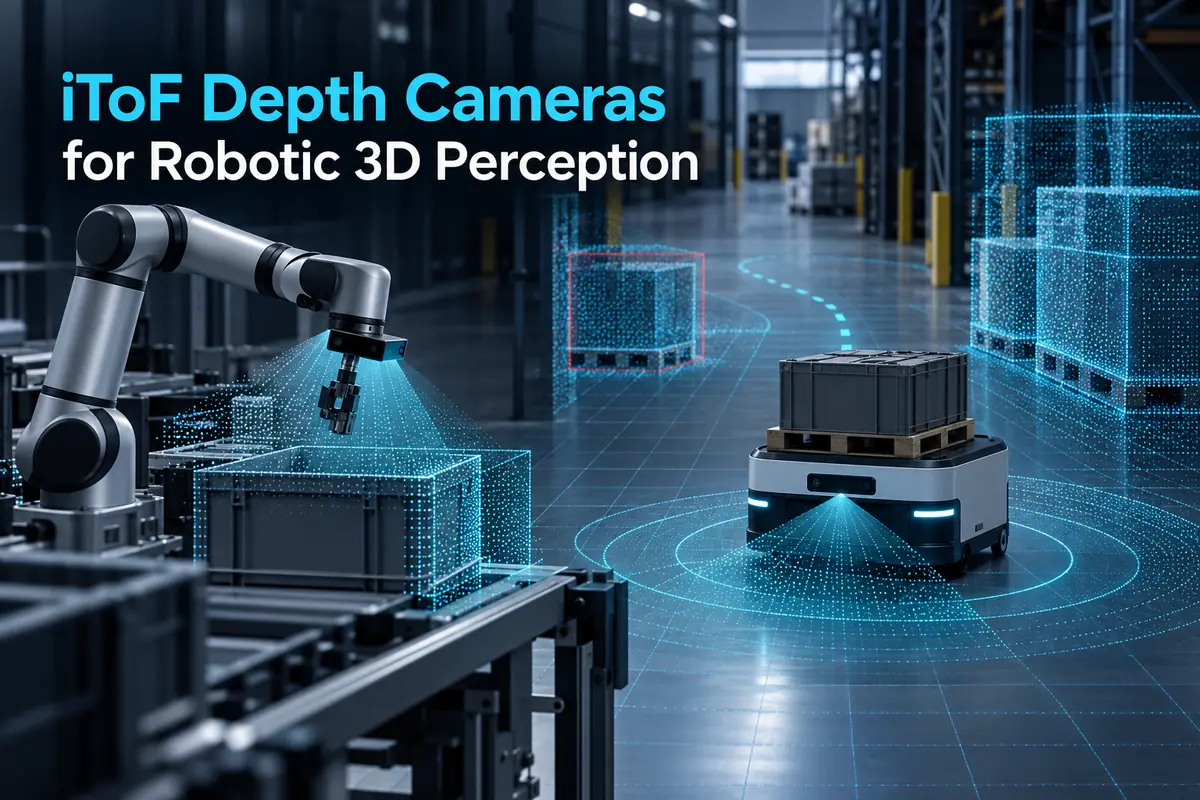
Helping Robots Truly Understand the World: How iToF Depth Cameras Are Transforming 3D Perception
iToF depth cameras provide dense depth data for navigation, obstacle avoidance and robotic manipulation, helping robots understand and interact with complex 3D environments.
From robotic arms performing precise tasks on factory floors to autonomous mobile robots moving through warehouses, robots must solve one fundamental challenge: how can they accurately perceive, navigate and interact with a complex three-dimensional world?
This is where indirect Time-of-Flight, or iToF, depth-sensing technology plays an increasingly important role.
What Is iToF Technology?
A conventional 2D camera captures colour, brightness and texture but cannot directly determine how far an object is from the camera. An iToF depth camera adds spatial information by measuring distance across an entire image.
The camera emits modulated infrared light into the environment. After the light reflects from surrounding objects, the sensor receives the returning signal and measures its phase shift. This information is then used to calculate distance and generate a depth value for each pixel.
As a result, the robot can understand not only what is in front of it but also the distance, size, shape and spatial position of surrounding objects. The output may be presented as a depth map or converted into 3D point-cloud data for further processing.
In simple terms, iToF technology acts as a robot’s “3D eyes.”
Why Is iToF Suitable for Robotic Vision?
Different 3D vision technologies offer different advantages.
dToF measures the round-trip travel time of emitted light more directly and is commonly used for longer-range distance measurement. iToF is particularly suitable for generating dense depth images at useful frame rates and can be efficiently integrated using mature CMOS processes.
Compared with passive stereo vision, iToF does not depend heavily on visible textures or clearly identifiable image features. Compared with many structured-light systems, it can provide real-time depth information across a wider range of industrial and robotic applications.
Actual performance still depends on ambient light, target reflectivity, multipath interference, optical design and calibration. However, its balance of spatial resolution, accuracy, frame rate, power consumption and system cost makes iToF an attractive choice for robotic 3D perception.
Three Core Applications of iToF Depth Cameras in Robotics
1. Autonomous Navigation and SLAM
Accurate navigation is essential for warehouse AMRs, AGVs, cleaning robots and service robots.
An iToF depth camera continuously captures the distance and shape of surrounding objects. Its depth maps and point clouds help the robot identify walls, shelves, equipment, people and available travel areas.
When combined with simultaneous localization and mapping, or SLAM, this information allows a robot to build a map of an unfamiliar environment while estimating its own position within that map.
The robot can then plan routes, adjust its movement and navigate more efficiently through changing environments.
2. Obstacle Avoidance and Industrial Safety
Robots working near people must be able to detect obstacles and changes in their surroundings quickly.
An iToF camera can monitor a robot’s working area and determine the position and distance of nearby people or objects. When an obstacle approaches the robot’s planned path, the perception system can provide real-time data to the motion controller or safety logic.
Depending on the system design, this information can be used to reduce speed, issue a warning, change the planned route or trigger a stop command.
In industrial environments, depth sensing can support restricted-area monitoring, collision avoidance, robotic workcell supervision and human–robot collaboration. Final safety performance depends on the design and validation of the complete safety system, not only the camera itself.
3. Object Detection, Positioning and Robotic Grasping
Flexible assembly, logistics sorting, depalletizing and agricultural automation require robots to understand an object’s position and orientation in three-dimensional space.
An iToF depth camera captures the object’s surface and spatial coordinates. Combined with vision algorithms, the robot can estimate its size, shape, position and pose before planning a suitable grasping path.
For example, an agricultural robot may use depth information to locate fruit and determine its position relative to surrounding branches. In logistics and manufacturing, robotic arms can use 3D data to identify mixed, overlapping or irregularly stacked objects for picking and sorting.
This capability is especially valuable in unstructured environments where objects do not always appear in fixed positions.
Market Outlook for Robotic 3D Vision
The development of embodied intelligence, humanoid robots, autonomous mobile robots and flexible manufacturing is increasing demand for reliable 3D perception.
As robots move from controlled demonstrations into warehouses, factories, commercial buildings and homes, they must understand environments that are dynamic, crowded and less predictable.
This transition is creating new opportunities for iToF cameras, stereo vision systems, dToF sensors and multimodal sensing technologies. Future robotic systems are also expected to combine depth cameras with RGB cameras, inertial sensors, audio, LiDAR and AI models to achieve more complete environmental understanding.
X-Dynamics iToF Solutions for Robotic Perception
Wuhan X-Dynamics focuses on high-precision industrial 3D vision products and solutions.
Our independently developed technologies cover optical simulation, hardware design, 3D calibration, depth correction, ISP processing and application-oriented AI algorithms. This enables us to support projects from initial sensor selection and testing through system integration and customized development.
The X-Dynamics industrial depth-camera portfolio includes several products designed for different robotic and industrial requirements:
X-D1100 Series
The X-D1100 Series combines a wide field of view, longer working range and high-accuracy depth sensing. It is suitable for applications that require broader environmental coverage and reliable 3D perception.
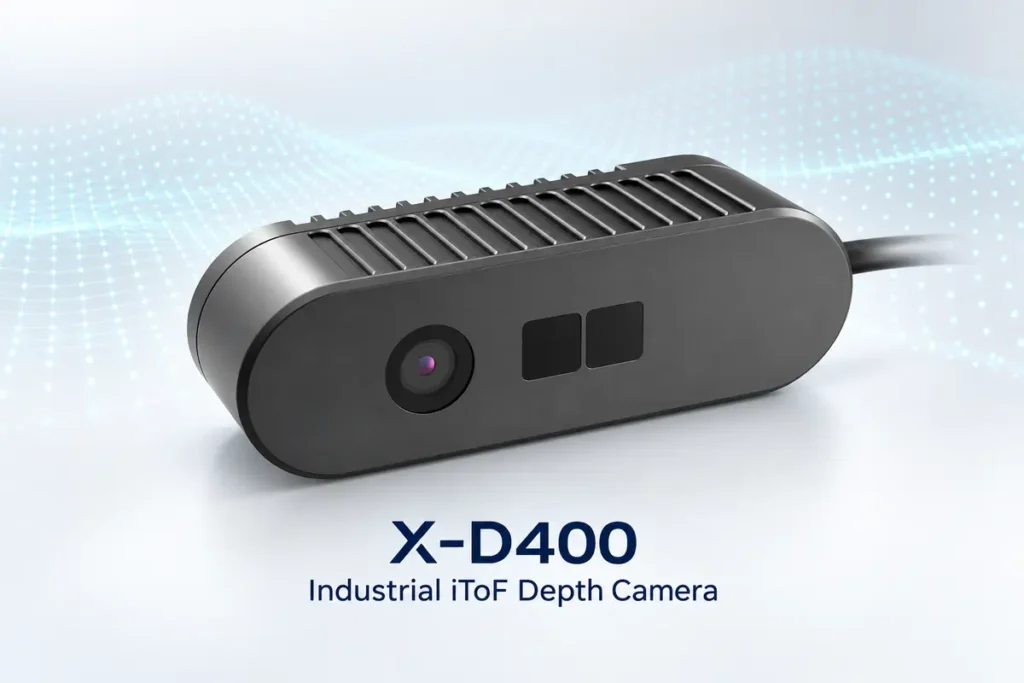
X-D400 Series
The X-D400 Series features a compact structure and full-range accuracy of up to 1% under specified operating conditions. Its small size makes it suitable for robots and embedded systems with limited installation space.
X-D500 Series
The X-D500 Series integrates application-oriented AI capabilities and supports a range of industrial and human-sensing applications requiring both depth data and intelligent analysis.
Selected X-Dynamics products can achieve accuracy of up to 0.5%, depending on the model, configuration, target and operating environment. Industrialized designs also support performance in challenging conditions, including strong ambient light and multi-camera installations.
Supporting Diverse Industrial Applications
X-Dynamics iToF cameras, algorithms and software solutions can support applications including:
- AGV and AMR obstacle detection
- Industrial safety monitoring
- Robotic guidance and object positioning
- Logistics volume measurement
- People counting and occupancy analysis
- Posture and human-feature sensing
- Rail-transit monitoring
- Industrial automation and inspection
In addition to standard products, X-Dynamics provides technical consultation, interface adaptation, sample evaluation and ODM customization for different integration requirements.
Giving Robots Reliable 3D Vision
From industrial automation and warehouse logistics to service robots and embodied intelligence, iToF depth cameras are helping machines move beyond simply capturing images.
By providing real-time spatial information, they allow robots to understand where objects are, how environments are structured and how to interact with the physical world more safely and efficiently.
With independently developed technologies and a growing industrial 3D vision portfolio, X-Dynamics continues to help customers build more capable robotic perception systems for real-world applications.