SPAD Technology Explained: The Foundation of Next-Generation Photodetection
Learn how SPAD technology enables sensitive photon detection, precise dToF ranging and compact sensing for industrial and embedded applications.
As optical sensing, 3D perception and laser ranging technologies continue to evolve, photodetectors are becoming increasingly sensitive and precise. The industry has progressed from conventional PIN photodiodes and avalanche photodiodes (APDs) to Single-Photon Avalanche Diodes, commonly known as SPADs.
A SPAD is capable of detecting extremely weak light signals down to the single-photon level. Its high sensitivity, precise timing capability and compatibility with semiconductor integration make it a key technology for direct Time-of-Flight (dToF) ranging, LiDAR, 3D imaging, low-light detection and other advanced sensing applications.
How Does a SPAD Work?
A SPAD is a type of avalanche photodiode operated in Geiger mode. Unlike a conventional PIN photodiode or linear-mode APD, which typically needs to accumulate a measurable amount of light before producing a useful electrical signal, a SPAD can respond to the arrival of an individual photon.
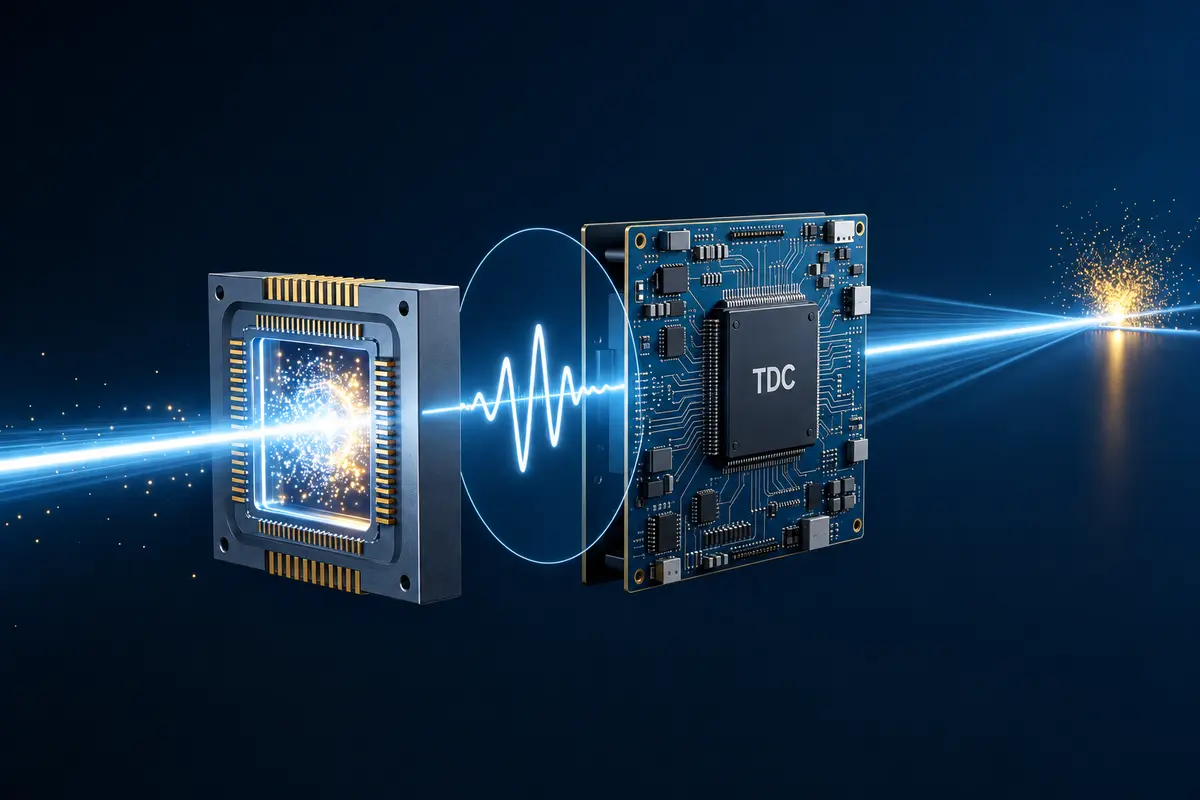
The device is reverse-biased above its breakdown voltage. When a photon enters the active area and generates an electron-hole pair, it can trigger a rapid avalanche multiplication process. This converts an extremely weak optical event into a detectable electrical pulse.
A quenching circuit then stops the avalanche and resets the SPAD so that it can detect the next photon.
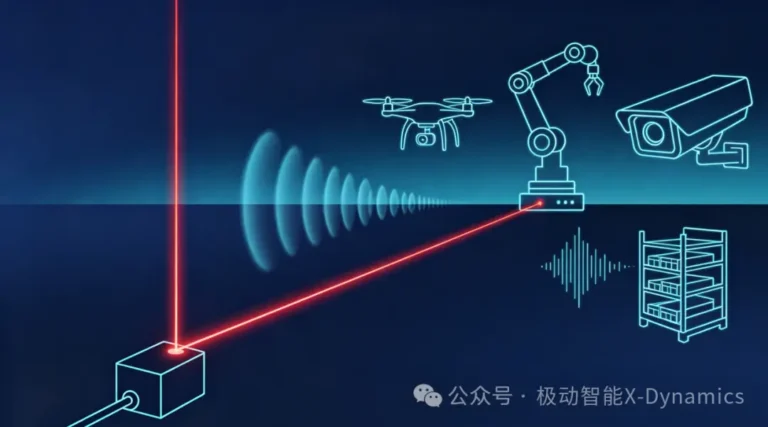
When combined with a Time-to-Digital Converter (TDC), the system can record the time interval between the emission of a laser pulse and the arrival of the reflected photons. The target distance is calculated using:
Distance = Speed of Light × Time of Flight ÷ 2
The division by two accounts for the laser travelling from the sensor to the target and then returning to the receiver.
This direct timing method is the foundation of dToF ranging. In comparison, indirect Time-of-Flight (iToF) systems estimate distance by measuring the phase shift of modulated light. The two technologies serve different sensing requirements, while SPAD-based dToF is particularly suitable for applications requiring long-range detection, precise timing or reliable operation with weak return signals.
Key Advantages of SPAD Technology
1. Single-Photon Sensitivity
The most important feature of a SPAD is its ability to detect extremely weak optical signals.
In long-distance ranging, only a small proportion of the emitted laser light may return to the receiver. The reflected signal becomes even weaker when the target has a dark, low-reflectivity or irregular surface.
SPAD-based receivers can detect these limited returning photons and accumulate them over multiple laser pulses. This allows the system to extract useful distance information without relying only on significantly higher laser power.
Actual detection performance still depends on the complete optical system, including the laser source, receiving optics, wavelength, photon detection efficiency, target reflectivity and signal-processing algorithms.
2. Reliable Performance in Strong Ambient Light
Sunlight and artificial infrared sources can introduce large amounts of background noise into an optical sensing system. SPAD-based dToF sensors address this challenge through precise time correlation.
The receiver looks for photons arriving within an expected time window after each laser pulse. Time gating, optical filtering and histogram-based processing help distinguish the valid return signal from randomly arriving background photons.
This makes SPAD-based ranging well suited to outdoor and industrial environments. However, resistance to ambient light is achieved by the complete sensor architecture rather than by the SPAD device alone.
3. Precise Timing Resolution
SPAD technology can support very fine photon-arrival timing. When paired with a high-resolution TDC, it enables accurate measurement of short time intervals and small differences in optical path length.
For laser ranging and LiDAR systems, this timing capability supports precise distance measurement and spatial reconstruction. It can also be used to identify more than one return signal from the same laser pulse.
Multi-return detection is useful when the laser encounters several objects or surfaces along its path, such as vegetation in front of a building, transparent materials or partially obstructed targets.
Beyond ranging, precise photon timing is also valuable in fluorescence lifetime imaging, quantum communication, time-resolved spectroscopy and other scientific applications.
4. Compact Semiconductor Integration
Modern CMOS-compatible processes make it possible to integrate SPAD detectors, quenching circuits, TDCs and digital processing units into compact semiconductor devices.
This level of integration helps reduce the size of the complete sensing module and simplifies its installation in space-limited equipment. It also supports the development of portable and embedded products such as:
- Handheld laser rangefinders
- UAV sensing modules
- Mobile robots
- Smart access-control devices
- Industrial measurement equipment
- Compact 3D sensing systems
Power consumption depends on the number of SPAD pixels, measurement frequency and processing architecture. Nevertheless, highly integrated SPAD designs can provide an effective balance between sensitivity, size and energy consumption.
5. Solid-State Reliability
SPAD detectors are solid-state semiconductor devices without mechanical scanning components inside the detector itself. This gives them strong potential for stable operation in systems exposed to vibration, shock or frequent movement.
When combined with appropriate thermal management, calibration and protective housing, SPAD-based modules can be adapted to industrial facilities, outdoor equipment, cold-chain logistics and other demanding operating environments.
The final environmental rating and operating temperature range depend on the design of the complete sensor module.
Where Is SPAD Technology Used?
SPAD technology is already being adopted across industrial, consumer, medical and scientific markets.
In industrial automation, it can support AGV and forklift obstacle detection, cargo dimension measurement, safety monitoring and robotic environmental perception.
In consumer and commercial equipment, SPAD-based sensors can be used in laser rangefinders, UAVs, smart locks, mobile devices and other compact sensing products.
Medical and life-science applications include fluorescence lifetime imaging, time-resolved optical analysis and selected biomedical sensing systems. In scientific research, SPAD detectors are widely associated with LiDAR imaging, astronomy, quantum optics and single-photon measurement.
The sensing principle remains similar across these applications, but the optical design, detector array, timing electronics and algorithms are optimized for different measurement requirements.
From SPAD Technology to a Practical Product: XD-S200S Laser Ranging Module
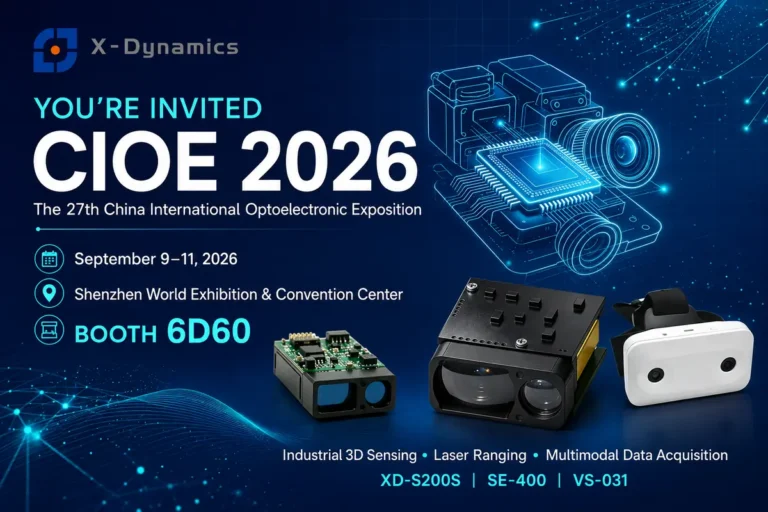
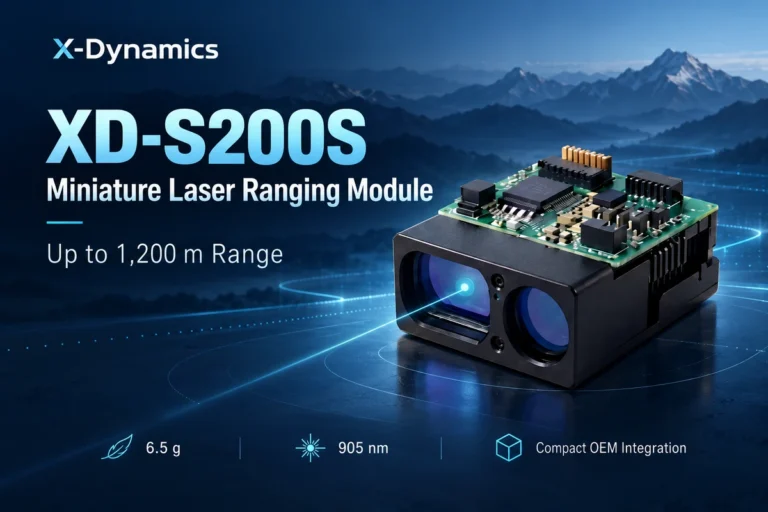
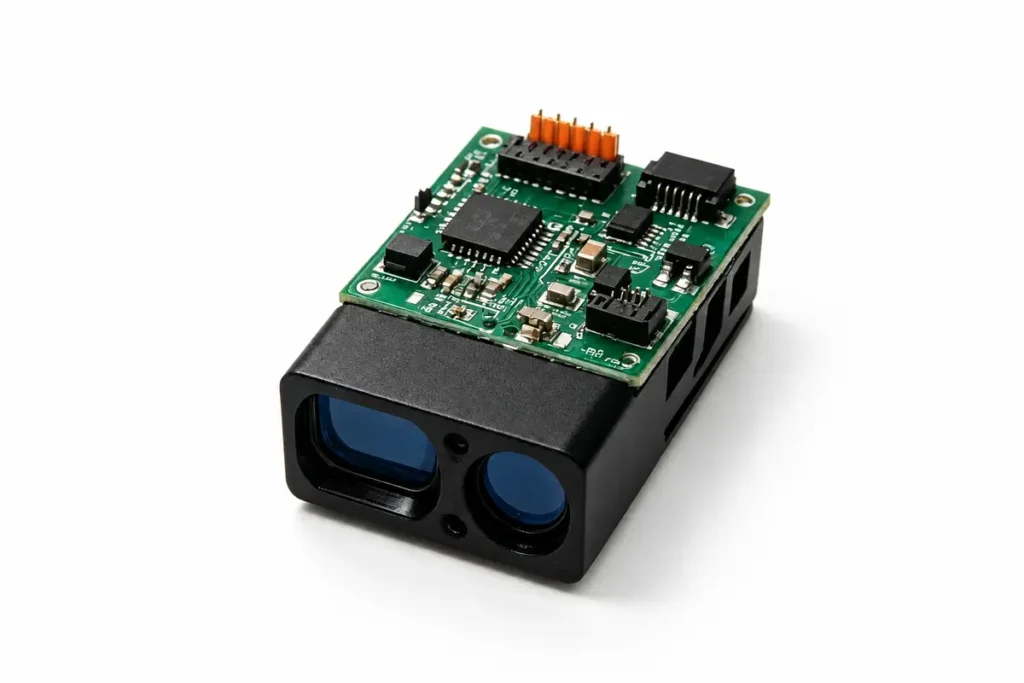
The XD-S200S laser ranging module represents the practical application of SPAD-based dToF technology in a compact product.
It combines a SPAD detector architecture with a high-precision TDC to measure the return time of laser pulses. This allows the module to detect weak reflected signals and perform stable distance measurements in demanding environments.
Its built-in multi-return processing helps identify different reflected signals within the measurement path, while temperature compensation is designed to improve data consistency across changing operating conditions.
With its compact, highly integrated design, the XD-S200S can be embedded into handheld rangefinders, industrial sensing terminals, intelligent optoelectronic equipment and other devices requiring reliable distance measurement.
By converting single-photon detection and precise timing into usable distance data, the module makes advanced SPAD technology easier to integrate into real-world products.
The Future of SPAD-Based Sensing
As CMOS SPAD arrays continue to improve, the technology is moving toward higher resolution, smaller size, lower system cost and more efficient processing.
Future SPAD-based sensors are expected to provide denser depth information and better integration with intelligent perception algorithms. This will expand their role in 3D vision, robotic navigation, industrial automation, human-machine interaction and biomedical imaging.
SPAD is more than a highly sensitive photodetector. It is becoming an important foundation for the next generation of intelligent devices that need to perceive distance, depth and extremely weak optical signals with greater precision.