From Human Demonstrations to Robot Learning: X-Dynamics VS031 First-Person Data Collection
Recording a human demonstration involves more than capturing the final result of a task. For robotics researchers, the process also matters: how the person approaches an object, how their hands interact with it, and how the surrounding scene changes throughout the operation. First-person data collection offers a way to observe…
Recording a human demonstration involves more than capturing the final result of a task. For robotics researchers, the process also matters: how the person approaches an object, how their hands interact with it, and how the surrounding scene changes throughout the operation.
First-person data collection offers a way to observe these activities from the demonstrator’s perspective. By combining visual observations with synchronized motion and audio data, it provides material for developing robot learning and multimodal perception workflows.
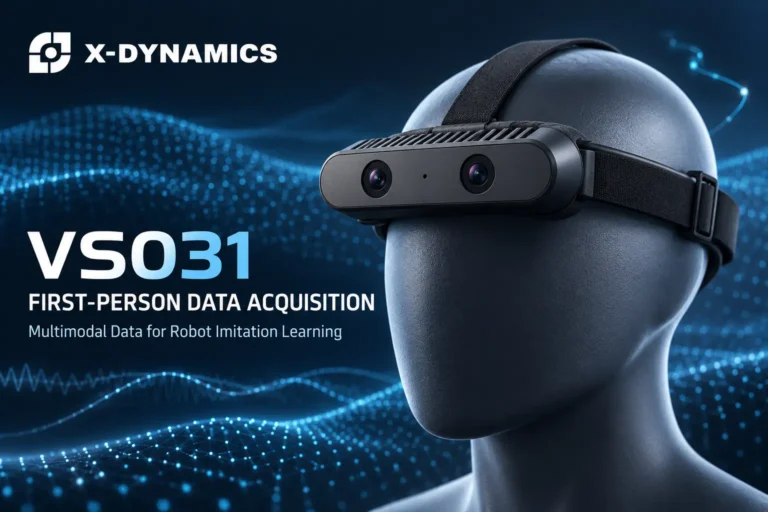
The X-Dynamics VS031 wearable EGO stereo data collection device brings these recording capabilities together in a head-mounted platform, supporting data acquisition for embodied AI research, robot imitation learning and manipulation policy development.
Capturing Tasks from the Demonstrator’s Perspective
The VS031 uses a head-mounted stereo camera configuration to record an egocentric view of human activities. This viewpoint follows the wearer during a demonstration, capturing the visible relationship between hand movements, objects and the workspace.
For manipulation research, these recordings can help document the sequence of an operation—from approaching and handling an object to completing a task. They provide visual observations that researchers can review, organize and prepare for downstream learning workflows.
The usefulness of a recording depends on what remains visible throughout the task. Camera positioning, hand occlusion and the arrangement of the workspace should therefore be considered when planning a collection session.
Stereo Vision, Inertial Data and Audio in One Platform
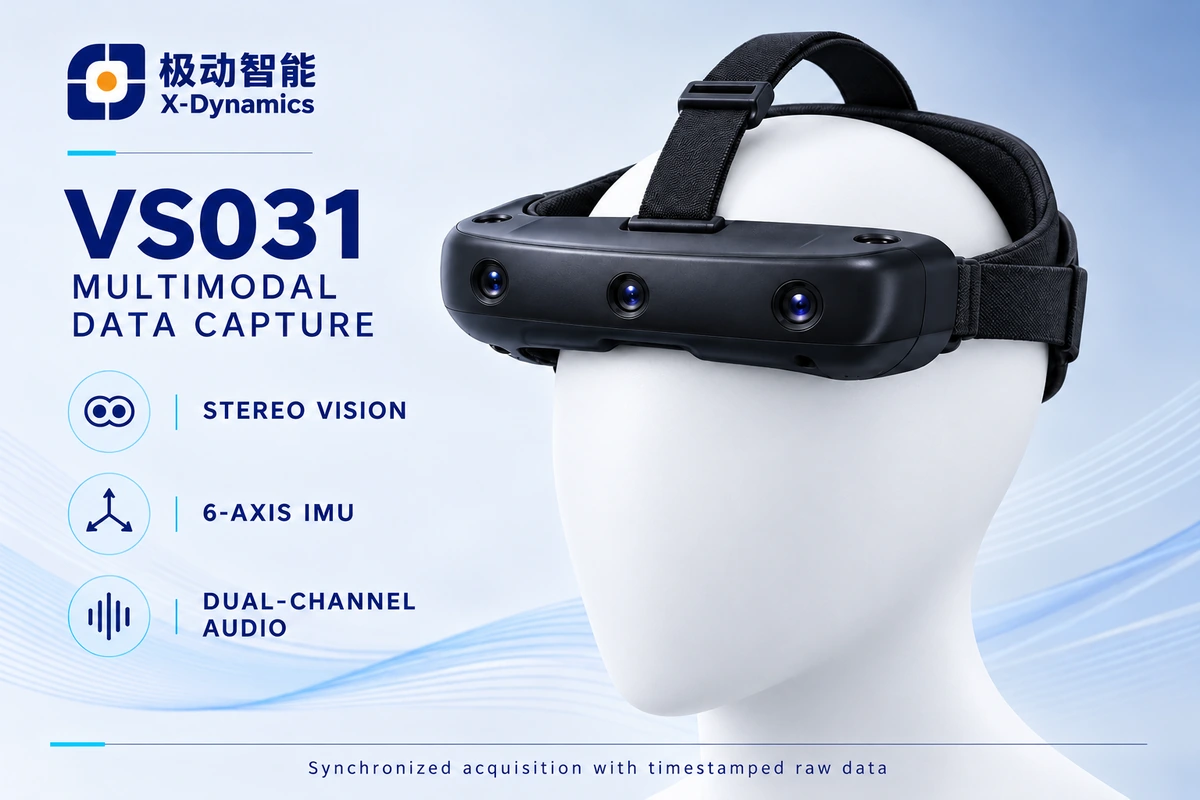
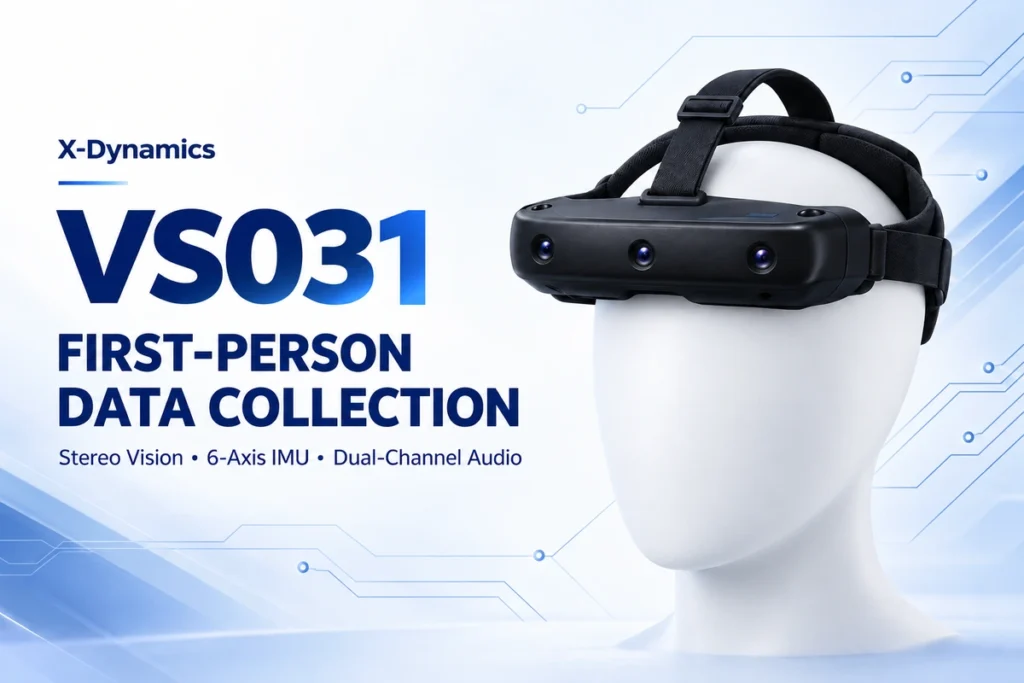
The VS031 integrates stereo vision, a six-axis inertial measurement unit (IMU) and dual-channel audio, with synchronized multimodal acquisition.
These streams capture different aspects of a demonstration. Stereo cameras record visual observations from two viewpoints, while the IMU provides inertial measurements associated with the device’s movement. Audio adds another source of information about the recorded activity and its surroundings.
Collecting these streams together gives research teams a broader record of a task than a single video stream alone. Depending on the project, the data can be prepared for workflows involving visual observations, motion information, audio or combinations of these modalities.
Timestamped Raw Data for Downstream Processing
The VS031 outputs standardized raw data with precise timestamps. This provides a basis for organizing recordings and associating observations from different sensor streams during subsequent processing.
For research teams, access to raw data allows the preparation process to be adapted to the intended task. Recordings may require calibration, quality checks, annotation, segmentation or conversion into the format expected by a training pipeline.
The device supports the acquisition stage of this workflow. Developing a usable training dataset also requires decisions about demonstration quality, task coverage and the relationship between recorded human actions and the robot’s available controls.
Supporting Imitation Learning and Multimodal Model Development
The VS031 is designed to support data collection for robot imitation learning, manipulation policy learning and multimodal model training.
In an imitation learning workflow, human demonstrations can provide observations of how a task is performed. First-person recordings help preserve the demonstrator’s view of the interaction, including the objects being handled and the visible progression of the task.
For manipulation policy development, researchers can use recorded sequences as part of a broader dataset preparation and learning process. The required annotations, robot action data and training methods depend on the system being developed.
Multimodal research can also draw on the coordinated visual, inertial and audio streams. Which modalities are used—and how they are combined—remains a choice for the downstream model and application.
Extending Observation with a Seven-Camera IMU Module
Alongside the VS031, X-Dynamics offers a seven-camera IMU module for projects requiring additional viewpoints and broader environmental observations.
The module combines three forward-facing cameras, four fisheye cameras and two IMUs with hardware-level synchronization. Its camera arrangement is intended to cover both the close-range hand operation area and the surrounding environment.
This platform supports data acquisition for algorithm research in hand keypoint localization, visual-inertial SLAM and camera–IMU calibration. These are downstream development directions supported by the collected data; the specific processing pipeline depends on the project.
The VS031 and seven-camera module address different acquisition requirements. Selection should consider the required viewpoints, recording setup, sensor configuration and intended use of the dataset.
Connecting Data Collection with Robotic Visual Perception
Human demonstration recording is one part of a wider robotics workflow. Robots also need suitable visual observations when interacting with objects and operating in a workspace.
X-Dynamics’ industrial 3D vision portfolio includes modules for robot head, torso and wrist mounting positions, addressing applications such as workspace observation, end-effector guidance and close-range manipulation.
Other application directions include volume measurement, individual and stacked object separation, depalletizing and palletizing. Each requires a suitable combination of sensing hardware, processing algorithms and system integration.
Together, these product directions connect human-centered data acquisition with visual perception for robotic applications.
Discuss Your Data Collection Requirements with X-Dynamics
A useful evaluation starts with a clear description of the task to be recorded. Research teams should consider the required viewpoints, sensor streams, synchronization needs, output formats and downstream processing workflow.
X-Dynamics welcomes discussions with robotics developers, embodied AI researchers and system integrators evaluating the VS031 or seven-camera IMU module.
Contact our team to discuss product specifications, data outputs and integration requirements for your project.